23 Tattoo Filler Ideas That Make Sleeves and Patchwork Tattoos Feel Complete
Sometimes the smallest tattoos are the ones that finally make everything click. You can have a collection of gorgeous pieces and still feel like the arm is missing something because of those narrow gaps, awkward corners, or stretches of bare skin between designs. That is exactly where tattoo filler ideas earn their place. From tiny stars and botanical sprigs to bold blackwork, honeycomb, flowing lines, and traditional motifs, filler can turn separate tattoos into a sleeve that feels thoughtful, balanced, and completely yours.
The best part is that filler does not have to disappear into the background. It can be subtle enough to simply connect existing pieces or interesting enough to become part of the personality of the sleeve. Whether you love patchwork, florals, celestial designs, American traditional work, or something more abstract, these ideas show just how creative those in-between spaces can become.
1. Swirls and Dotwork Between Bold Old-School Motifs
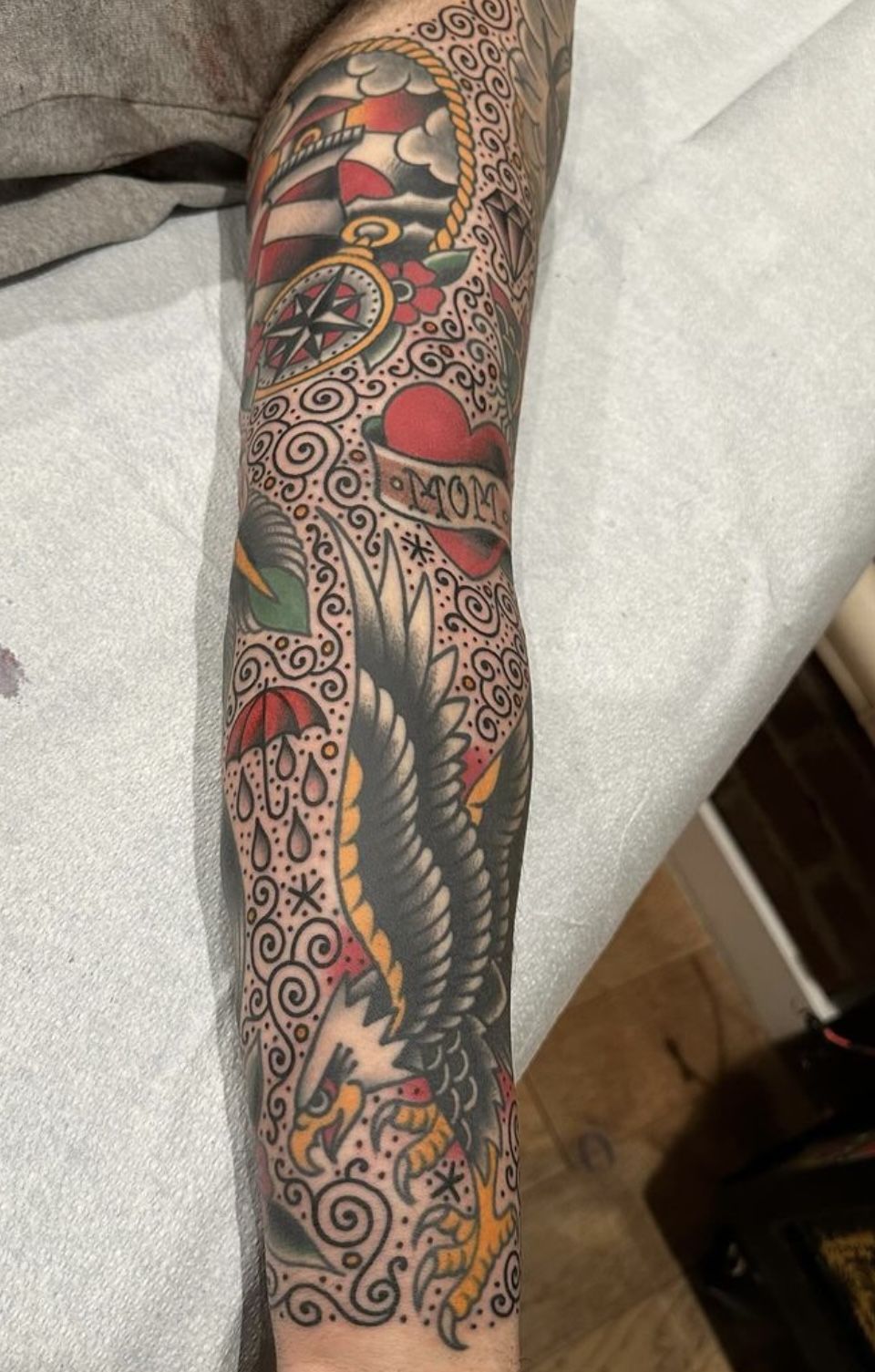
When a sleeve already holds big, confident images, the spaces between them can either feel awkward or become part of the story. Here, curling black swirls, scattered dots, tiny starbursts, and decorative marks weave around an eagle, heart, compass, and other bold pieces. The result has the wonderfully collected feeling of American traditional tattooing without looking like every inch was planned on the same day. I especially like how the filler gives the eye somewhere to travel instead of simply packing more large images into an already busy arm.
This kind of approach works beautifully for sleeve collections built from traditional designs because the filler can be shaped around almost any existing gap. Ask your artist to vary the scale of the curls and leave occasional areas of bare skin so the larger pieces remain easy to read. It is also a smart option for men or women who are gradually building a sleeve and want future additions to blend naturally with older work rather than looking squeezed into leftover spaces.
2. Abstract Curves for an Artful Blackwork Sleeve
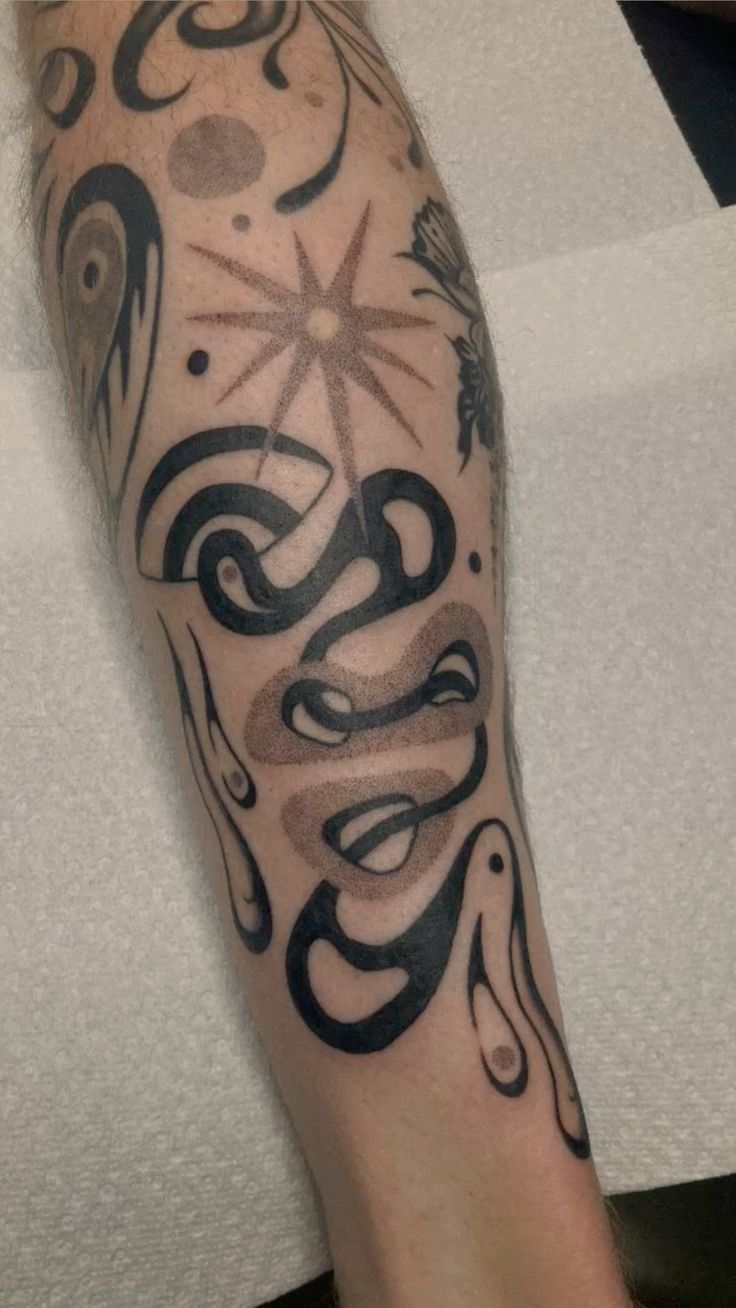
Not every filler has to be a tiny star, flower, or dot. These flowing black shapes turn negative space into something wonderfully strange and expressive, curling around the face like ribbons of ink. Soft stippling and a radiating star add another layer without competing with the main portrait. It feels artistic rather than decorative, which is exactly why this style can make separate pieces suddenly look like they belong in one thoughtful composition. There is movement everywhere, yet plenty of skin remains visible, keeping the whole design surprisingly light.
For a similar effect, bring your artist the existing shapes in your collection rather than choosing filler designs one by one. The curves should follow the anatomy and echo the weight of nearby lines. This works especially well for ideas, men’s backgrounds, or anyone collecting contemporary blackwork because irregular filler can be customized to narrow, curved spaces that standard motifs would never fit. Keeping some lines heavy and others softly shaded also prevents the finished sleeve from becoming one flat block of black.
3. Colorful Clouds, Sparkles, and Classic Mini Motifs
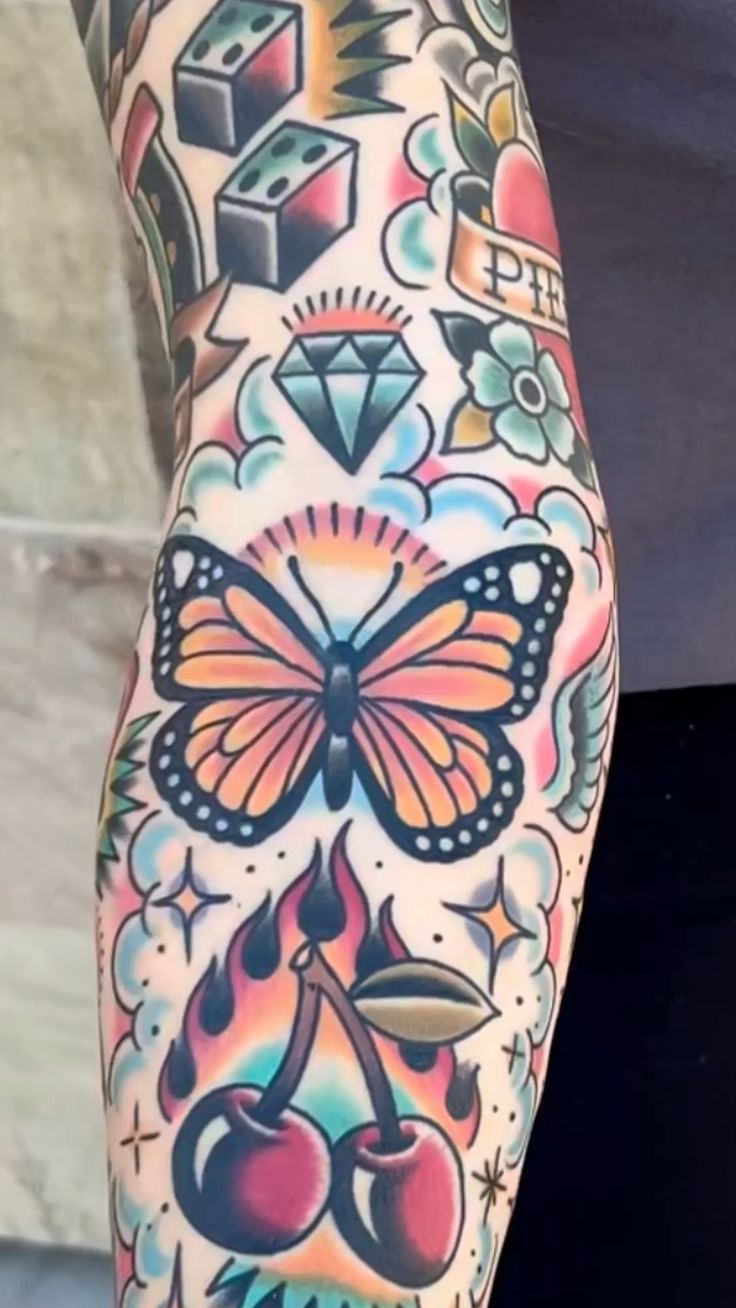
This is the kind of sleeve that makes you want to keep looking because every few inches reveal another playful detail. A butterfly, cherries, dice, a diamond, and flowers are surrounded by little clouds, dots, flames, and star-like accents that keep the color moving from one piece to the next. Instead of hiding the gaps, the filler celebrates them. That gives the arm the charm of a vintage sticker collection while still feeling polished and intentional—a great reminder that tattoo filler ideas can be cheerful, colorful, and full of personality.
What makes this combination special is the repetition of a limited palette. Coral, turquoise, yellow, black, and soft blue appear across several pieces, so even unrelated images feel connected. Small traditional filler works best when your artist repeats two or three colors already present in the larger designs rather than introducing a brand-new shade in every empty space. If you are planning ideas for sleeve layouts, leave enough skin around each motif to preserve its outline; the little clouds and sparkles can then bridge those spaces without making the composition muddy.
4. Honeycomb Texture Woven Through a Floral Sleeve
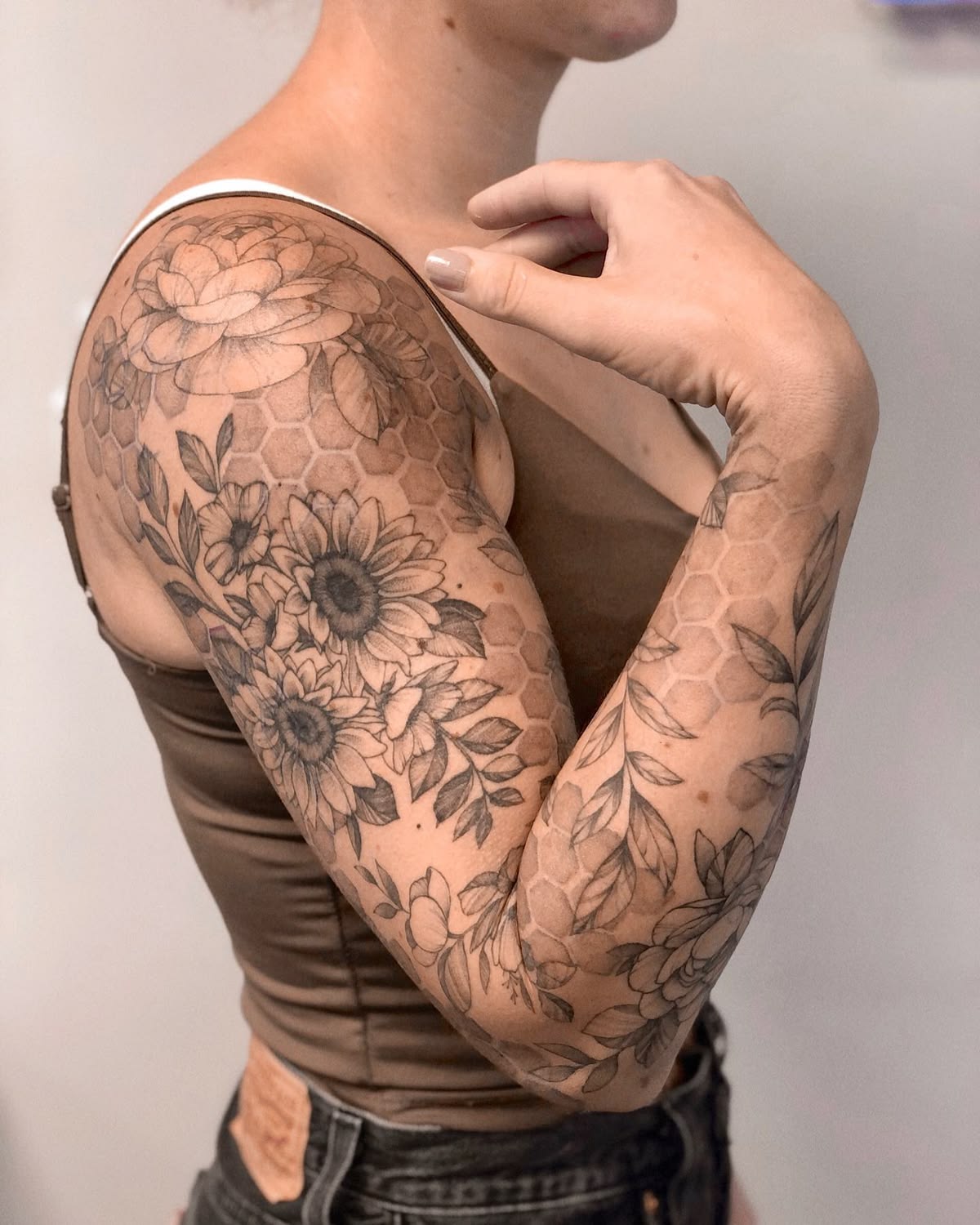
There is something especially satisfying about combining soft botanicals with crisp structure. Delicate blossoms and leafy branches move naturally around the arm, while sections of honeycomb appear behind them like a quiet secondary pattern. The geometric element gives the sleeve rhythm without stealing attention from the flowers, and the faded, partially disappearing hexagons make the background feel organic rather than rigid. It is a lovely option when you want filler to be visible and interesting but still want the main artwork to remain romantic and graceful.
Honeycomb backgrounds continue to work because they can be expanded almost endlessly as a sleeve grows. Rather than filling every open area with perfect hexagons, consider letting the pattern fade, break apart, or disappear beneath leaves and petals. That softer transition looks especially elegant for women who like botanical designs but want something a little less predictable than additional foliage. Fine lines and light shading also make future touch-ups easier because the background never has to compete with the darker centers and outlines of the flowers.
5. Bold Botanical Filler with Decorative Circular Details
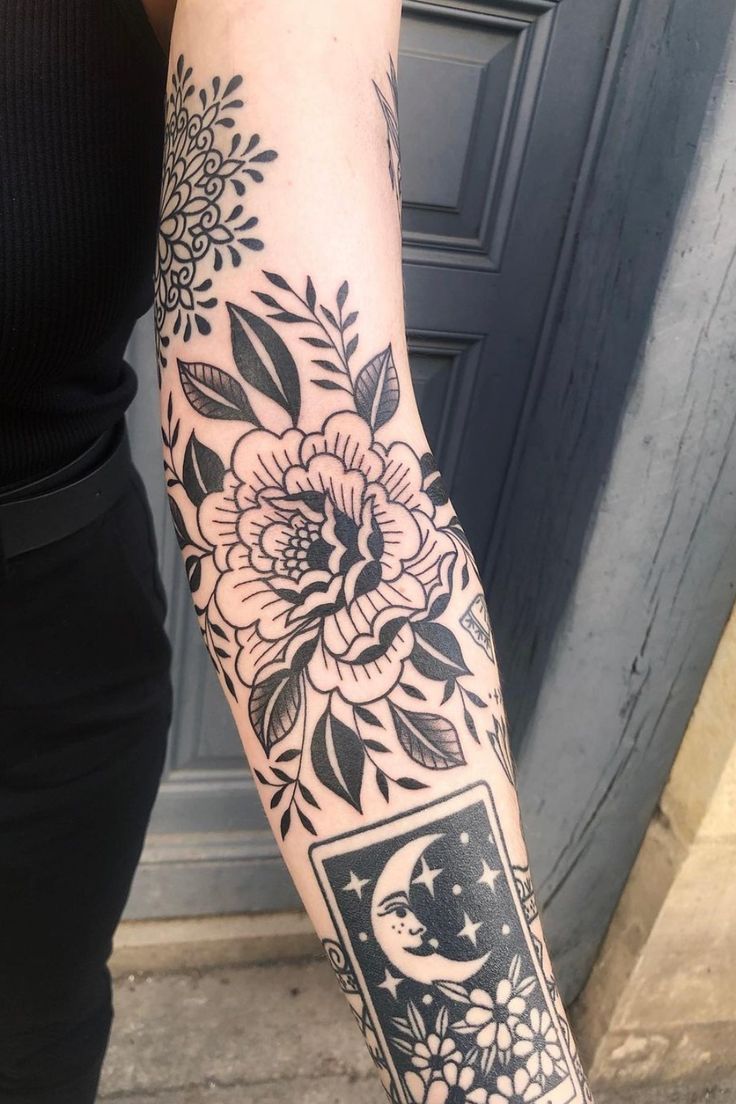
A large flower already creates a strong focal point, but the surrounding leaves and ornamental shapes are what make this arm feel complete. Dark foliage radiates outward from the bloom, naturally covering long, narrow gaps, while a decorative circular motif adds another visual anchor higher on the arm. Lower down, the moon imagery gives the collection a slightly mystical edge. It is a good example of how filler can support several different pieces without forcing everything to match perfectly. The sleeve feels personal, layered, and wonderfully collected.
If you love mandala details and flowers, this approach gives you plenty of flexibility. Leaves are especially useful because your artist can lengthen, bend, or shorten them to fit awkward spaces around elbows and forearms, while circular ornaments work beautifully in wider openings. The trick is balancing solid black areas with open linework so the arm does not become visually heavy. This combination also pairs easily with jewelry, sleeveless black clothing, or even a very simple outfit—the tattoo itself supplies enough texture and character to carry the look.
6. Tiny Stars and Dots Between Mystical Illustrations
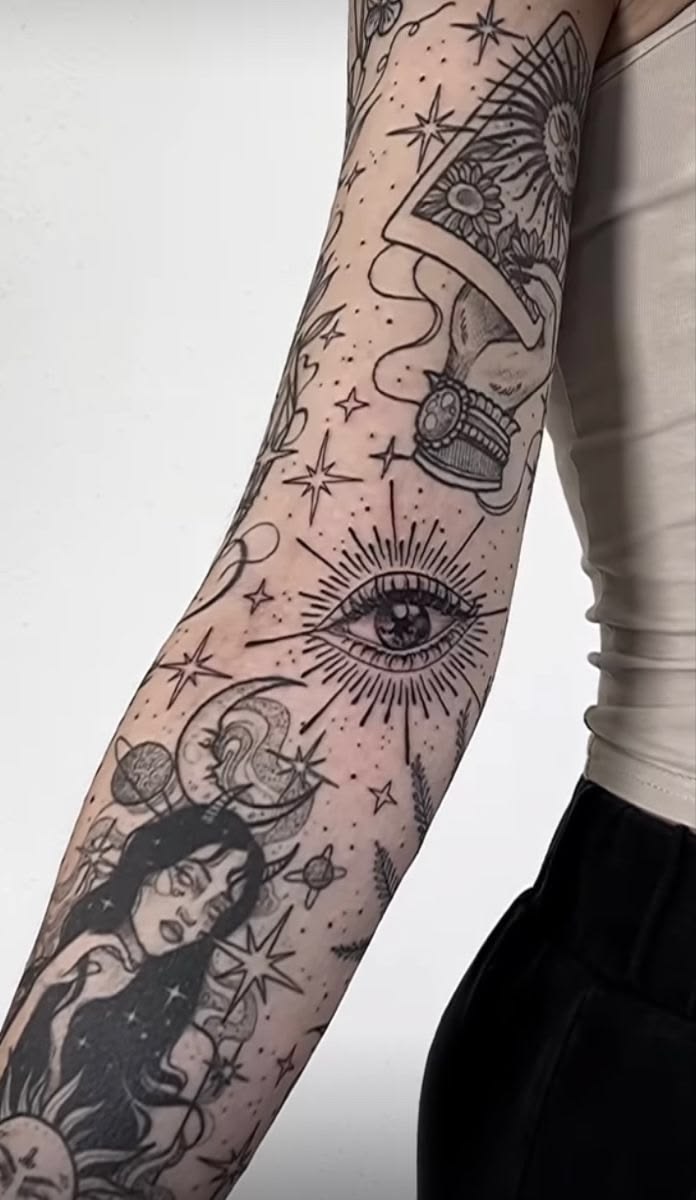
There is a lovely storybook quality to this arm, where celestial symbols, an eye, a figure, and other mystical pieces seem to float through the same little universe. Tiny stars, dots, and short radiating lines fill the open skin without making it feel truly “filled.” That is the magic here: the filler creates connection while preserving air and movement. If you tend to collect tattoos based on moments, meanings, or pure instinct, this kind of background can make wonderfully unrelated designs look as though they were always meant to share the same space.
The emotional payoff is surprisingly big because sparse filler often makes an unfinished collection suddenly feel intentional. For patchwork sleeves, start with the largest awkward gaps and add only enough stars or dots to create a visual path between the existing pieces. You can always add more later, but removing clutter is another matter entirely. This makes the style particularly appealing for women and men who enjoy evolving tattoos over time. The finished effect feels personal rather than overly designed, almost like a visual journal that keeps gaining new chapters.
7. Dragonfly Sparkles and Fine Dotwork
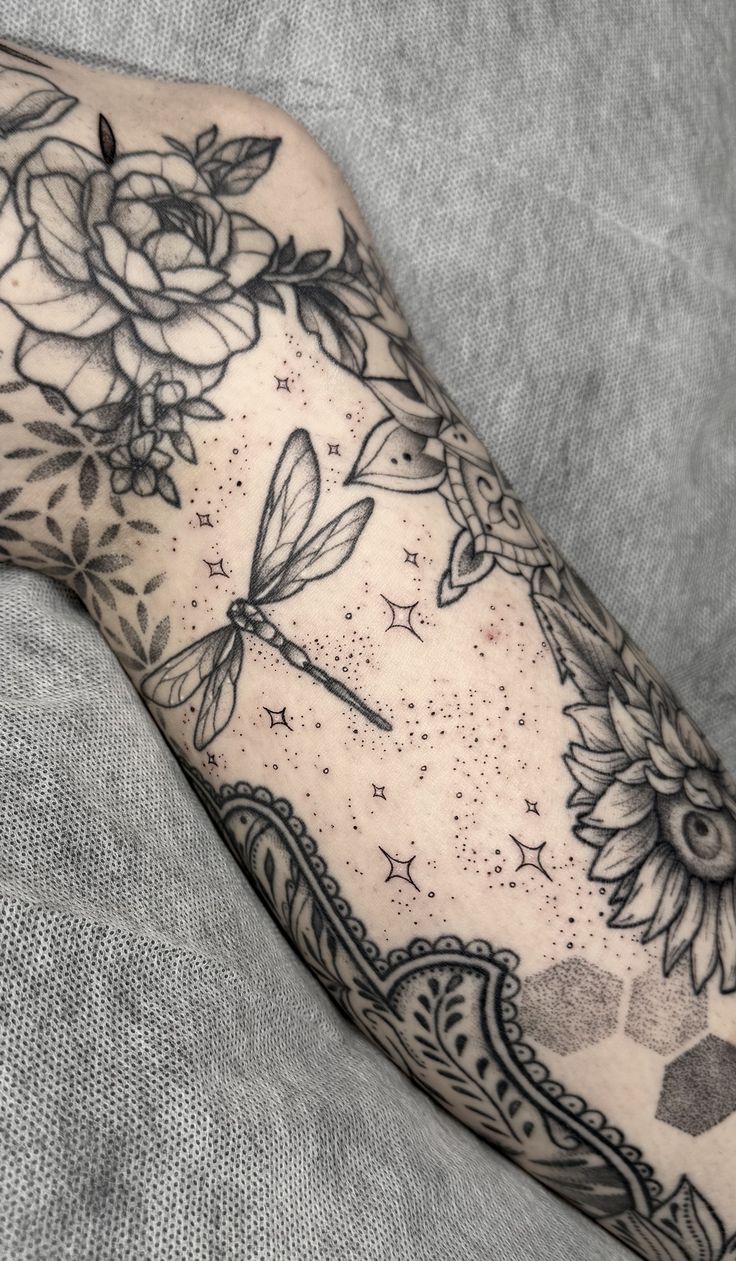
A dragonfly already has such a delicate, weightless feeling, and the tiny sparkles around it make the whole area seem almost suspended in the air. Fine dots drift between larger floral and ornamental pieces, while miniature four-point stars create just enough shine to wake up the negative space. Nothing feels crowded. In fact, the filler makes the larger tattoos easier to appreciate because it creates gentle transitions rather than hard, empty breaks. This is one of those ideas for women that feels whimsical without becoming overly sweet.
From a maintenance standpoint, sparse dotwork is wonderfully low fuss. There is less dense pigment than with a solid background, and small gaps between dots allow the skin to remain part of the composition. Ask for varied spacing instead of perfectly uniform stippling; a gradual fade usually looks more natural around the edges of larger pieces. This kind of filler is also easy to extend later if you add another tattoo nearby. A few fresh dots and sparkles can connect the new work to the old without redesigning the entire sleeve.
8. Botanical Gaps Filled with Leaves and Smaller Blooms
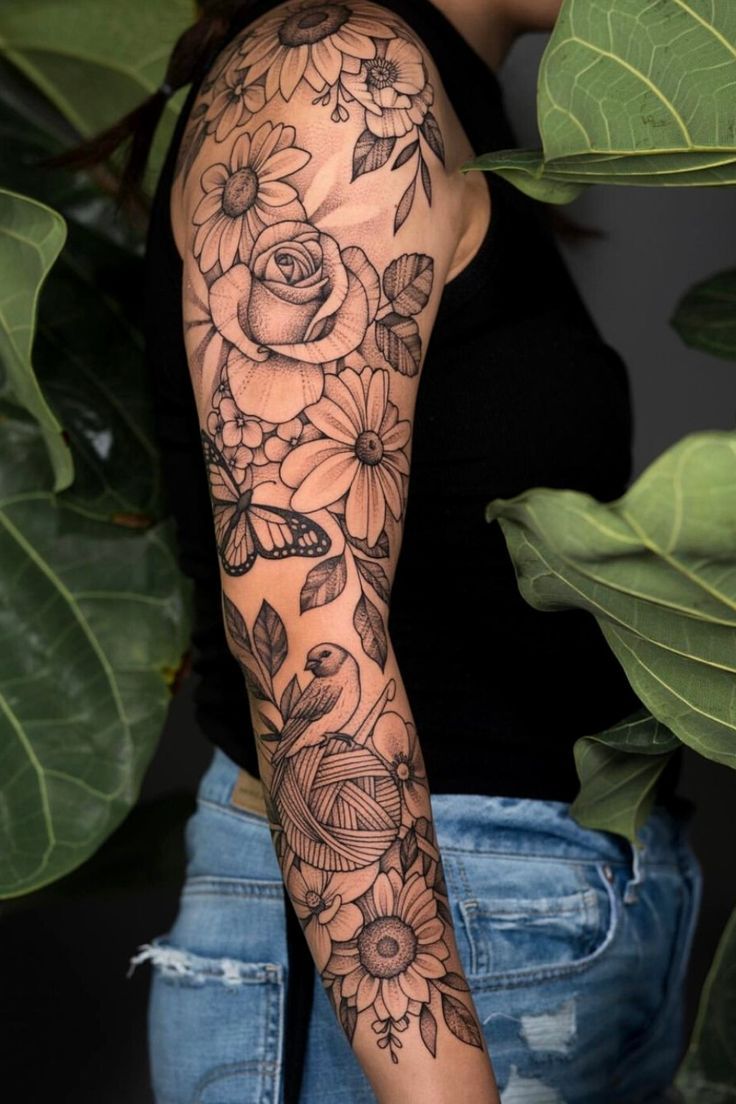
This sleeve has the lush feeling of a garden that grew naturally rather than being arranged in perfect rows. Roses, daisies, sunflowers, leaves, a butterfly, and a small bird create the main story, while smaller botanical details quietly occupy the narrow spaces between them. The filler never announces itself as filler; it simply continues the garden. That makes this an especially elegant choice if you dislike obvious background patterns but still want your separate pieces to read as one flowing composition from shoulder to forearm.
Compared with dots or geometric backgrounds, botanical filler feels softer because every little stem can curve with the body. It is ideal for sleeve collections already containing flowers or nature themes, and the scale can be adjusted almost endlessly. Ask your artist to reserve the largest leaves for open areas and use tiny buds or narrow sprigs near existing outlines. Keeping the smaller filler less detailed than the main blossoms preserves hierarchy, so the eye still lands on the rose, bird, or butterfly first instead of getting lost in a wall of equally complicated linework.
9. Tiny Nature Doodles for a Charming Patchwork Arm
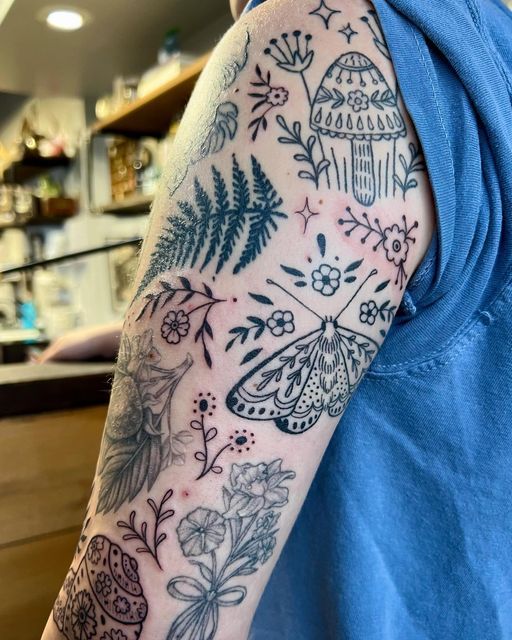
This arm proves that filler can have a sense of humor and sweetness. A moth, mushroom, fern fronds, tiny flowers, little branches, and star accents occupy the spaces between larger tattoos almost like doodles in the margins of a notebook. The different line weights keep the arrangement lively, while plenty of bare skin prevents it from becoming busy. There is no strict symmetry, and that is exactly why it works. The overall vibe is curious, creative, and a little bohemian—perfect for anyone whose tattoo collection grows one meaningful piece at a time.
Patchwork is especially forgiving when you enjoy many subjects but do not want a conventional full sleeve. Choose filler that repeats the mood rather than the exact subject of your existing tattoos: botanical pieces can sit beside celestial accents, insects, or tiny decorative symbols as long as the linework feels related. These ideas work for men and women alike and can be built slowly without requiring one huge appointment. Leave a few deliberate open zones, too. A patchwork arm often looks more stylish when it still has breathing room rather than every inch being claimed.
10. Delicate Honeycomb with Bees and Daisies
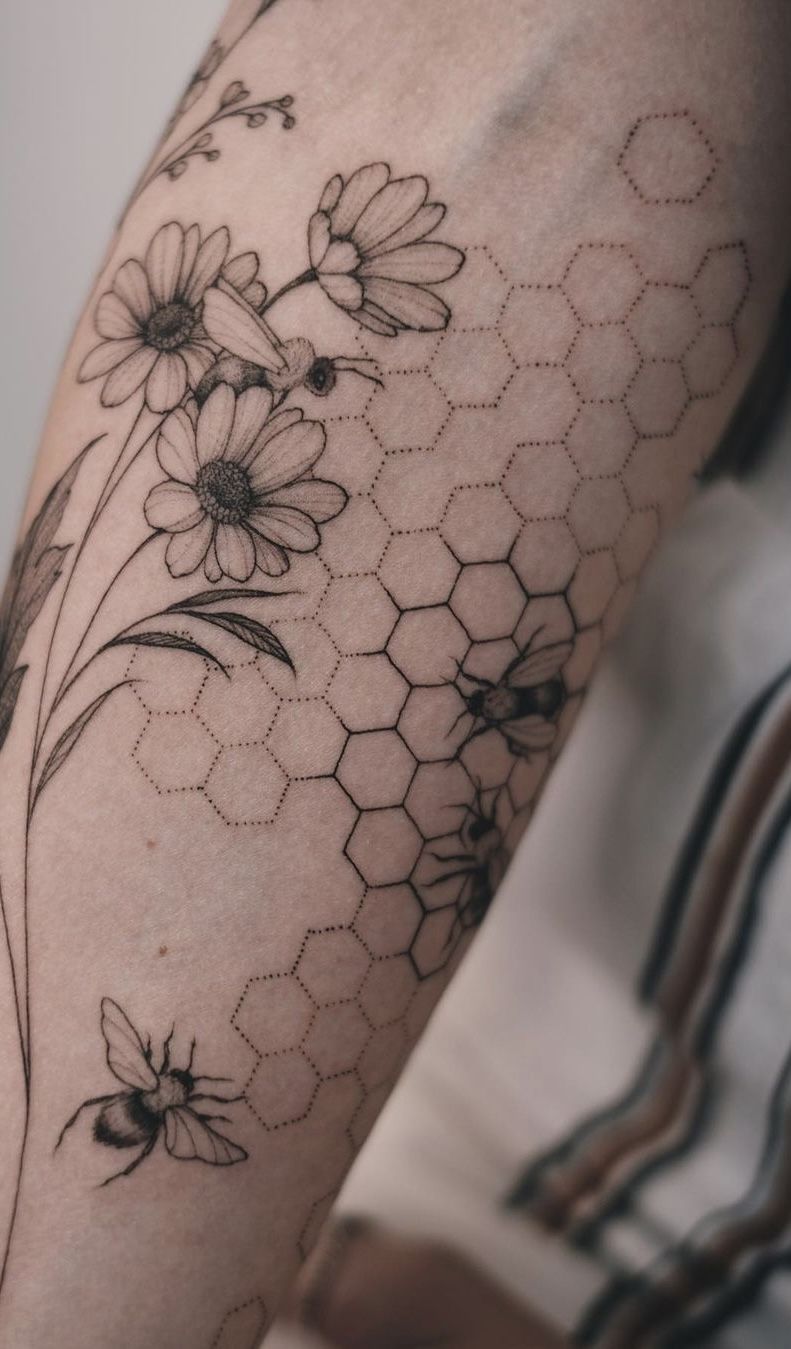
Honeycomb filler can easily become bold and graphic, but this version takes the opposite direction. Whisper-light dotted hexagons sit behind daisies and small bees, almost disappearing into the skin in places. That softness makes the insects and flowers feel like the true stars while the honeycomb quietly ties the entire idea together. I love the contrast between recognizable natural subjects and the subtle mathematical pattern behind them. It feels thoughtful and refined rather than overly literal, especially if you want a nature theme with just a hint of structure.
If you have been saving geometric tattoo filler ideas but worry they may look too rigid, this is a wonderful reason to try them now. Ask for sections of dotted or lightly outlined honeycomb rather than one continuous dark grid. Your artist can allow the pattern to fade around curved areas and disappear under petals, which makes the design sit more naturally on the arm. Adding only a handful of bees keeps the concept charming rather than themed to excess. It is a beautiful way to turn an awkward open space into a detail that looks completely intentional.
11. Bright Rope Knots as Old-School Gap Fillers
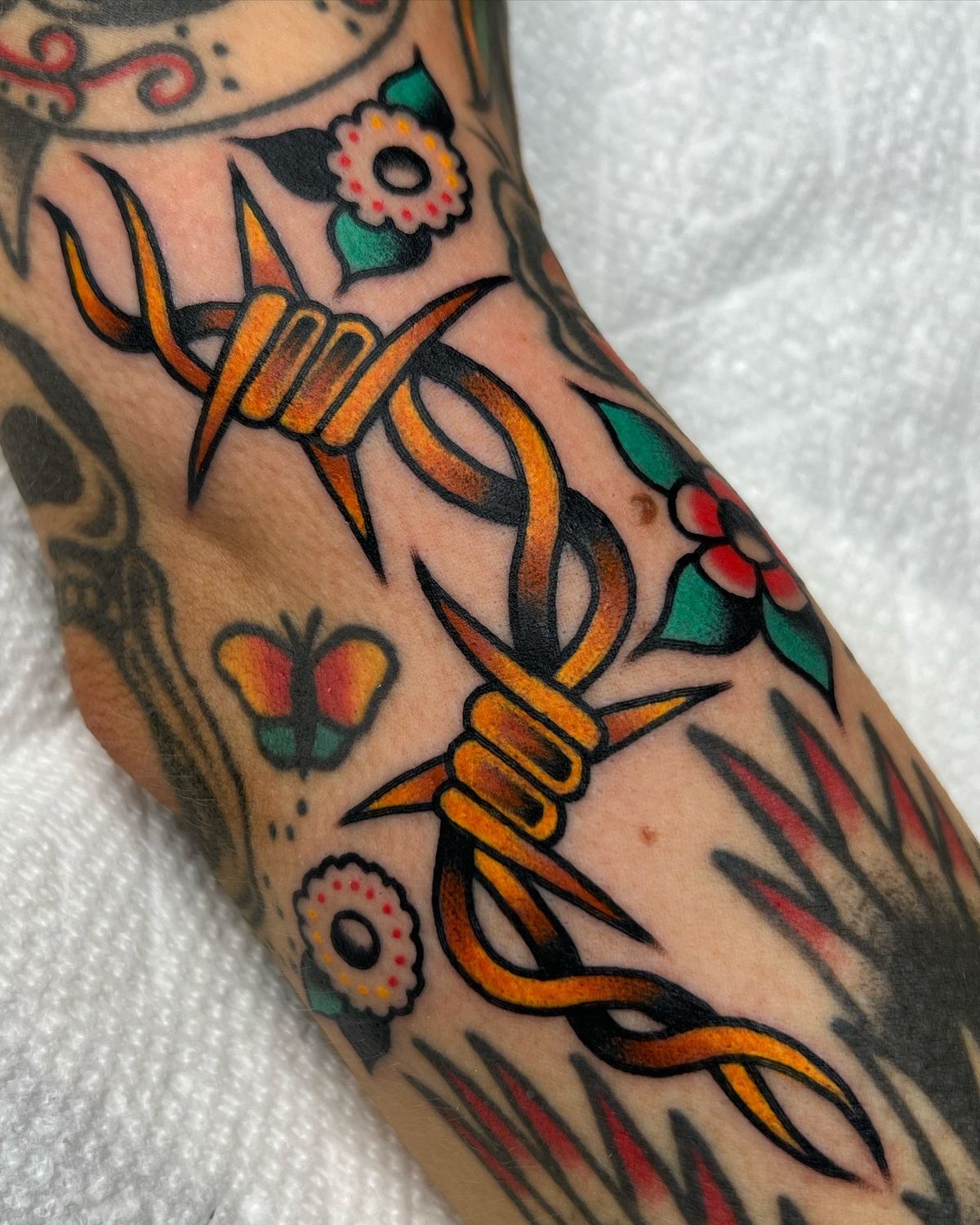
Sometimes the best filler is something bold enough to become a miniature tattoo in its own right. These twisting orange rope-like knots snake through narrow spaces between established pieces, bringing warmth and movement without needing much room. Small flowers and a tiny butterfly soften the tougher outlines around them, giving the whole collection that delightful mix-and-match quality associated with classic tattooing. Because the shape is long and flexible, it handles those frustrating gaps where a round motif simply would not fit.
This style is particularly useful for traditional or American traditional collections with strong black outlines. Your artist can stretch or curve the rope to follow the exact negative space, making it a practical filler for sleeve layouts near wrists, elbows, and between larger pieces. Keep the color palette connected to existing tattoos—one or two repeated shades usually look more cohesive than introducing several new ones. For men who prefer tougher imagery or women who enjoy bold vintage work, these flexible little designs can add personality without overwhelming the larger tattoos already in place.
12. Dense Floral Patterns for a Nearly Seamless Sleeve
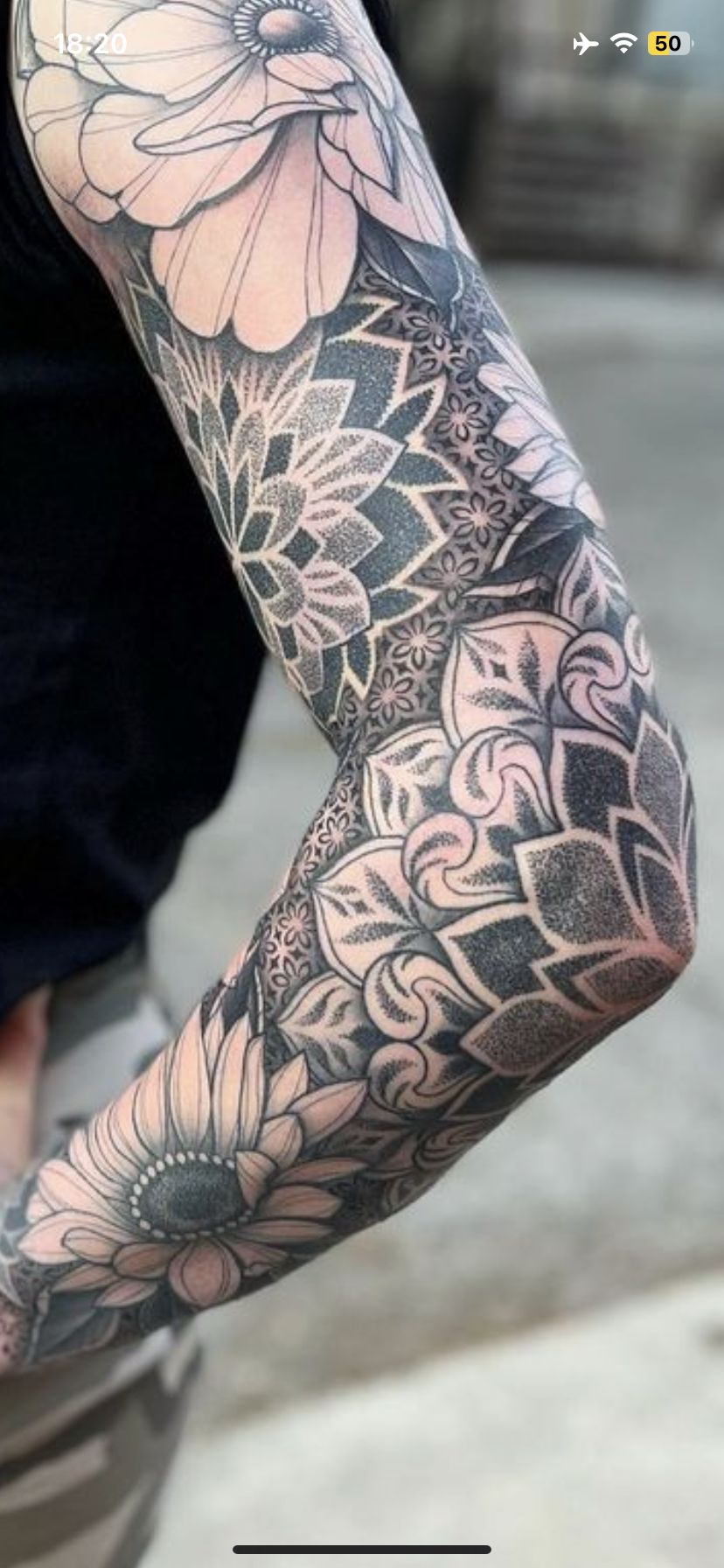
This is filler for someone who loves richness rather than empty space. Large blossoms create the main structure, but the gaps are packed with smaller floral patterns, dark leaves, stippling, and ornamental shapes until the arm reads almost like patterned fabric. There is still enough contrast to distinguish the bigger flowers, yet the background gives everything a luxurious, fully finished appearance. If sparse patchwork feels too unfinished for your taste, this dense approach delivers that satisfying sense that the sleeve has been composed from edge to edge.
Dense backgrounds require more planning than scattered filler because contrast becomes crucial. Ask your artist to keep the focal flowers lighter or larger while using smaller shapes and darker shading behind them. Mandala-inspired petals and miniature flowers are excellent for irregular gaps because they can be cropped naturally at the edges of existing pieces. This design also benefits from viewing the arm as a whole rather than filling one hole at a time. Mapping several gaps during the same session helps the pattern flow across the elbow instead of looking like separate patches added later.
13. Fine-Line Blossoms, Bees, and Floating Petals
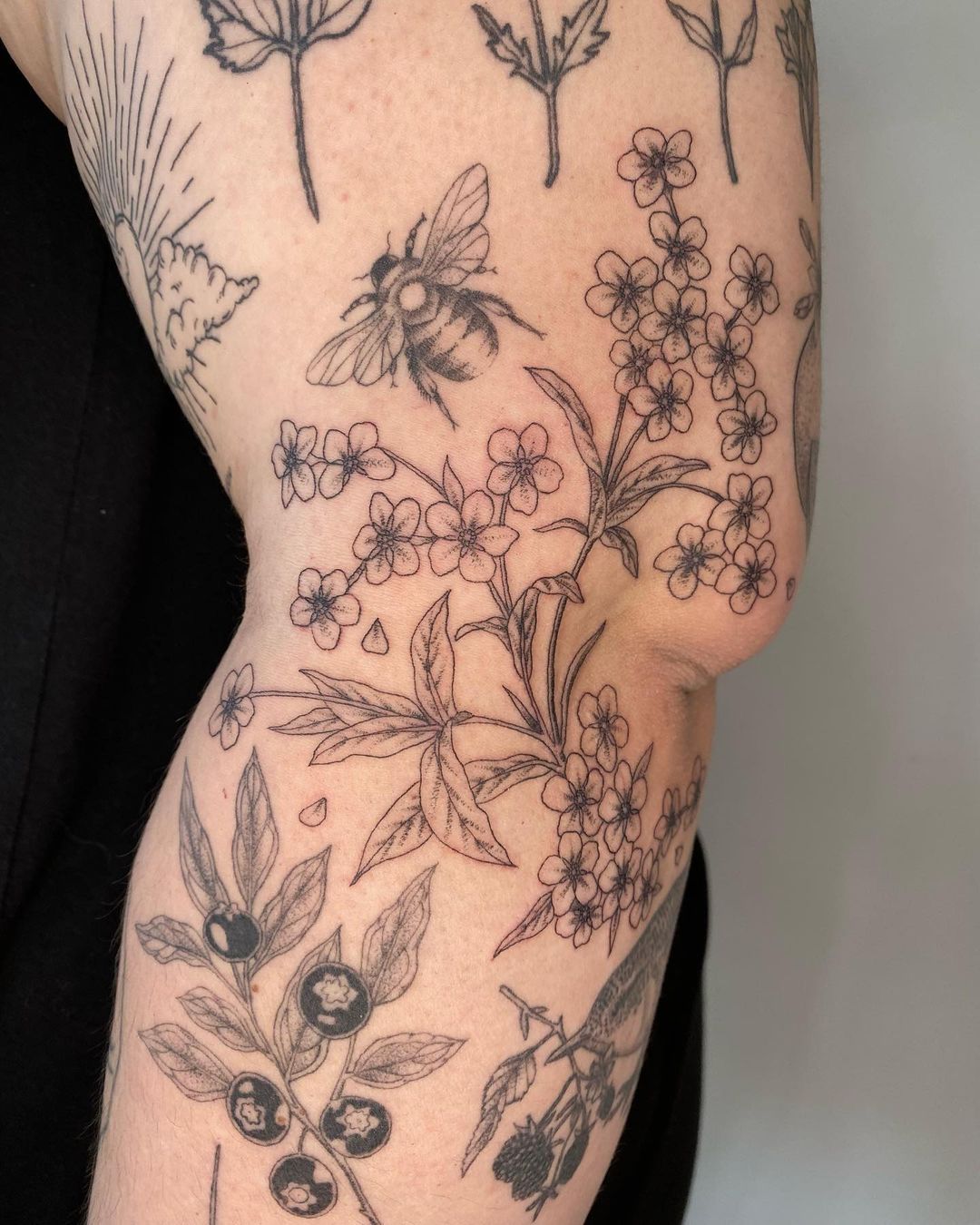
There is something quietly beautiful about filler that almost feels accidental. Small blossoms drift around the elbow, a bee hovers nearby, and tiny petals occupy those little spots that would otherwise look strangely empty. Instead of forcing everything into a single connected background, the design lets each element breathe. The effect is light, natural, and incredibly wearable. These are the sort of tattoo filler ideas that can soften a collection without changing its personality, especially when the existing work already leans toward fine botanical illustration.
For fine-line pieces, scale matters more than quantity. A few tiny flowers can finish a gap beautifully, while too many may blur the distinction between main tattoos and filler. This option suits anyone who likes ideas for women that feel delicate but not overly polished, and it works particularly well around elbows where rigid patterns can distort with movement. Ask for small variations in flower size and direction so the additions appear to grow around the existing artwork. The result feels fresh and spontaneous instead of looking like identical motifs stamped into every opening.
14. Bees, Flowers, and Honeycomb for a Nature-Themed Sleeve
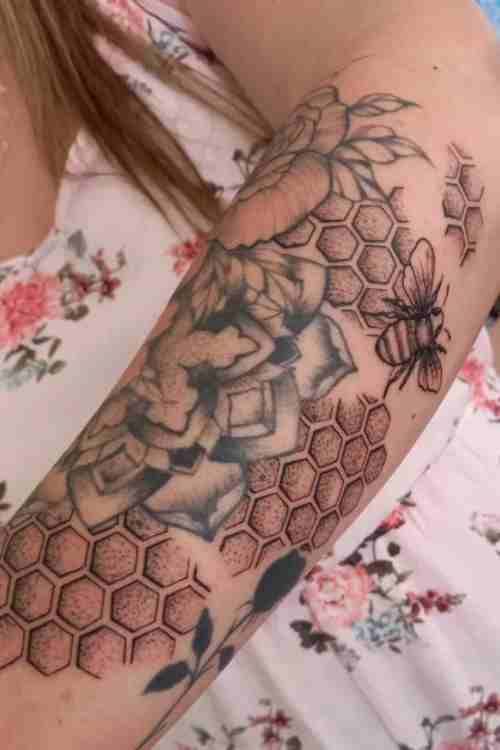
This combination feels richer and earthier than a delicate honeycomb design because the hexagons carry more shading and visual weight. Bees move through blossoms and leaves while the structured background fills wider stretches of skin, creating the impression that every element belongs to the same little ecosystem. It is decorative, yes, but there is also a pleasing logic to it: flowers feed bees, bees connect to honeycomb, and the filler becomes part of the narrative instead of merely covering an empty patch.
What makes this design unique is how easily its density can be adjusted. Darker honeycomb can anchor a large open section, while lighter or incomplete hexagons can transition toward the edges. If you are developing ideas for sleeve backgrounds around an existing nature collection, ask your artist to match the shading intensity of your older work so the new filler does not suddenly look much heavier. A few bees are enough to reinforce the theme. Leaving some cells incomplete also gives the artist room to adapt the pattern around future pieces if your sleeve is still growing.
15. Ornamental Lace-Style Filler with Dotwork Shading
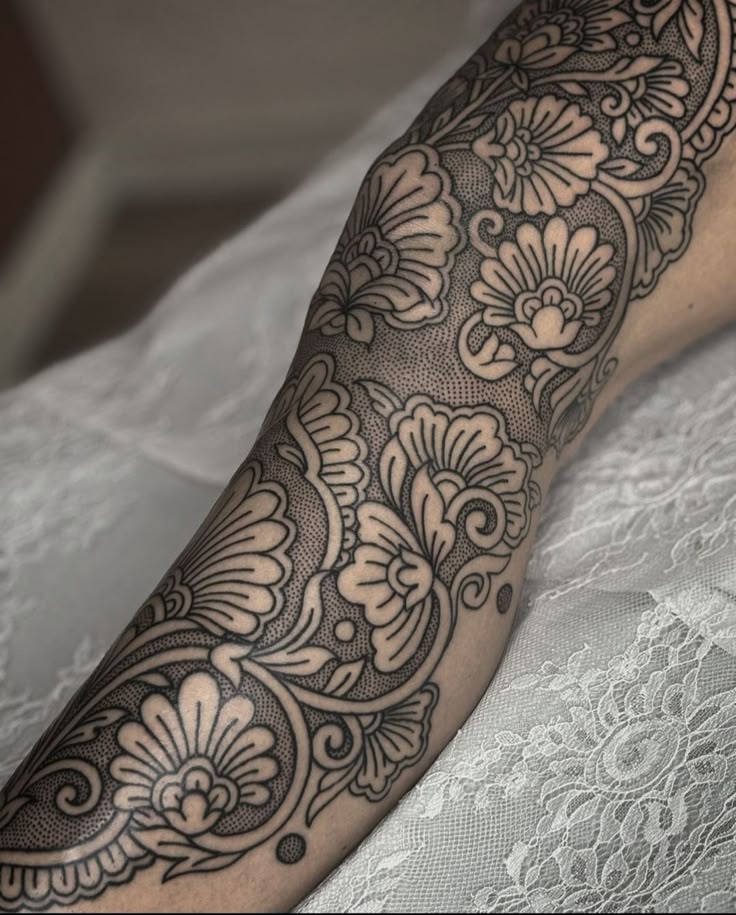
This ornate filler has the romance of lace translated into ink. Repeating petals, curling leaves, scalloped borders, and soft dotwork fit together so closely that the skin becomes part of an intricate textile-like pattern. Even though the design is dense, the open centers of the flowers keep it from feeling like solid blackwork. There is a beautifully mature elegance to this approach—decorative without being dainty, bold without being harsh. It would look equally at home as a background around older pieces or as the connecting language of an entire ornamental sleeve.
Ornamental and Filagree-inspired filler is having lasting appeal because it can be tailored precisely to the curves of an arm or leg. For the cleanest result, choose an artist who is comfortable repeating small symmetrical details while still adjusting them to the body. Dotwork backgrounds are useful for creating depth without completely closing the skin, but they do require patience during application. If your existing designs already contain florals, mandala shapes, or decorative borders, this kind of filler can make separate tattoos look dramatically more unified while keeping the overall palette timeless and monochrome.
16. Moth and Peonies with Bold Botanical Backgrounds
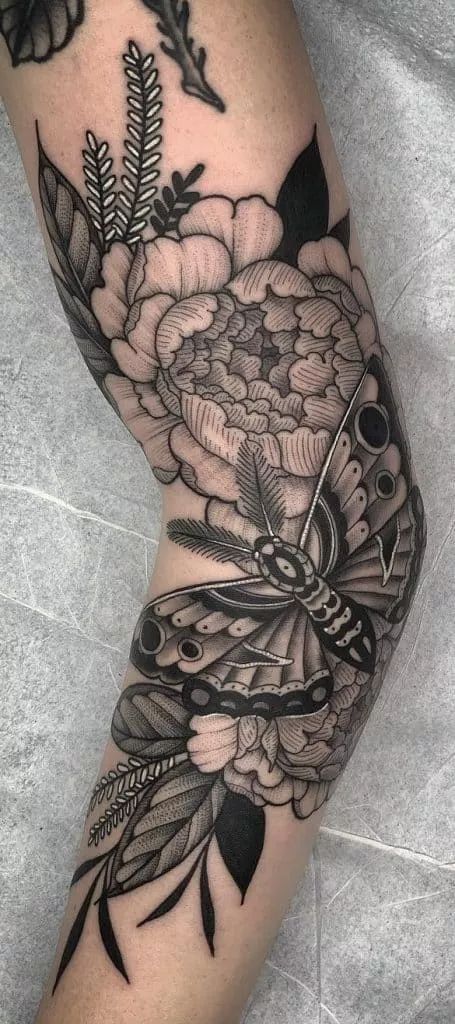
A moth placed among oversized peonies already makes a strong centerpiece, but the leaves and darker botanical shapes around it are what give this section such depth. Instead of relying on tiny filler symbols, the artist uses overlapping foliage to eliminate awkward gaps and guide the eye through the composition. The combination feels dramatic and romantic at the same time, with enough solid black to create contrast against the softer stippled petals. It is proof that filler does not always have to be small—it can simply be secondary in importance.
If you want a sleeve that feels more cohesive than Patchwork but less uniform than a single mural, this middle ground is worth considering. Use broad leaves as filler behind larger pieces, then reserve tiny sprigs for narrower openings. The moth remains easy to read because the surrounding shapes are simpler than its patterned wings. This strategy is especially useful around joints, where flexible foliage can bend visually with the arm. Keeping one repeated shading style across the flowers, leaves, and insect also helps new additions blend with older work rather than looking freshly pasted on.
17. Tiny Natural Curiosities Between Illustrative Pieces
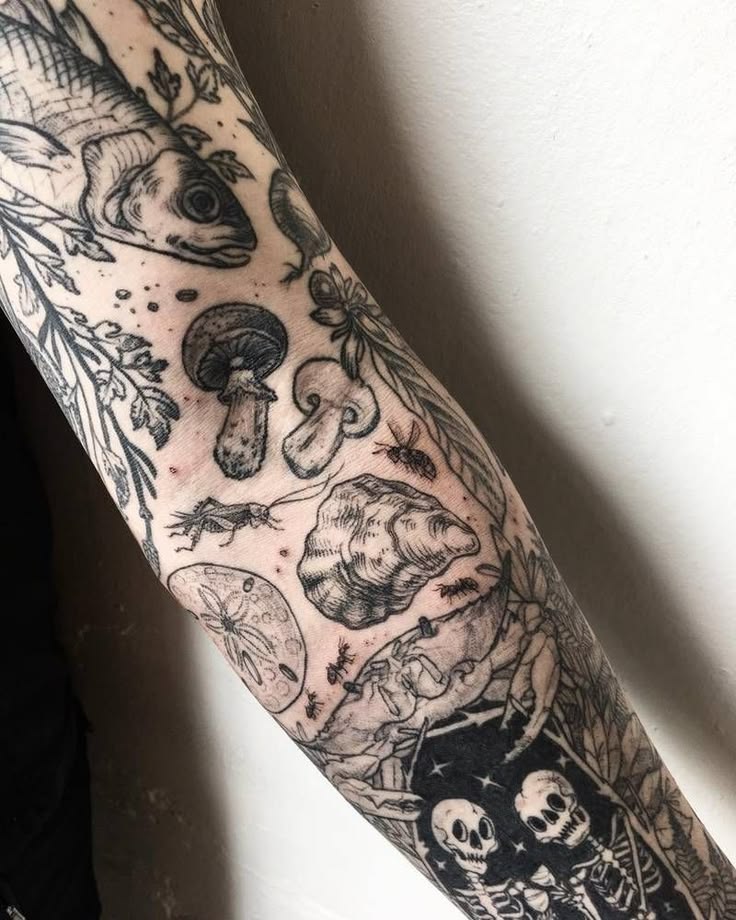
This arm feels like the pages of an old naturalist’s sketchbook brought to life. Mushrooms, insects, shells, fish, leaves, bones, and tiny scattered marks create a fascinating collection where even the smallest spaces have something curious to discover. The filler is not repetitive; instead, it continues the theme with miniature objects that would be too small to act as main tattoos elsewhere. I love the slightly eccentric energy of it. Nothing needs to match perfectly because the shared illustrative style is what holds all the pieces together.
For collectors who already have several detailed nature designs, this approach gives the sleeve a wonderfully specific attitude. Rather than adding generic stars or dots, make a list of tiny subjects related to your theme—seed pods, insects, mushrooms, stones, or leaves—and let the artist choose which shapes best fit each gap. This works for men and women who prefer storytelling over symmetry. The key is varying the silhouettes, so a round mushroom is balanced by a long twig or insect. That keeps the composition lively and prevents the filler from turning into visual wallpaper.
18. Flowing Black Shapes as Modern Organic Filler
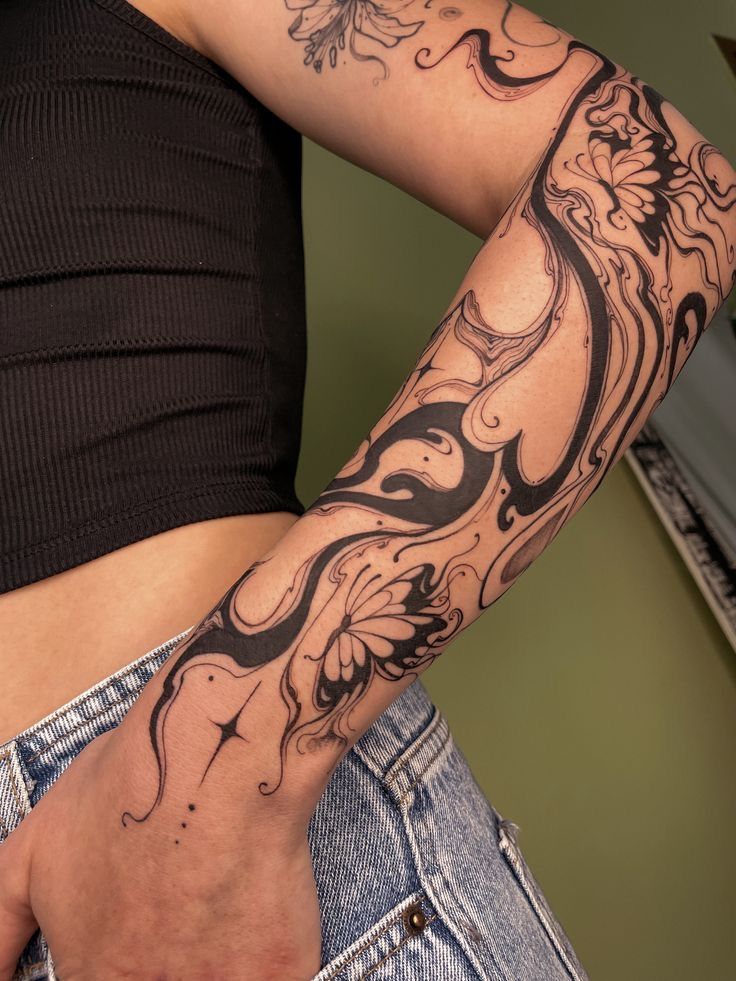
This is filler with serious movement. Long, liquid black curves wind around the arm, stretching between floral details and wrapping naturally toward the wrist. The forms feel part flame, part vine, and part decorative flourish, and that ambiguity gives the design a modern edge. Instead of seeing where one tattoo ends and another begins, your eye follows the sweeping lines through the entire composition. It is a beautiful example of using negative space deliberately—some areas are intensely dark while others remain completely open, creating a strong rhythm along the arm.
Organic black filler is a great alternative when geometric patterns feel too precise and tiny motifs feel too cute. Your artist can sketch the curves directly around existing pieces, adjusting every bend to suit your anatomy and the remaining spaces. Because solid black carries a lot of visual weight, it is best introduced in several balanced areas rather than one huge patch. Pairing it with lighter linework keeps the sleeve dimensional. If you have been wanting a dramatic change without adding another obvious object, these abstract forms can transform disconnected tattoos into something that feels genuinely designed.
19. Dark Abstract Shapes Around Woodland Mushrooms
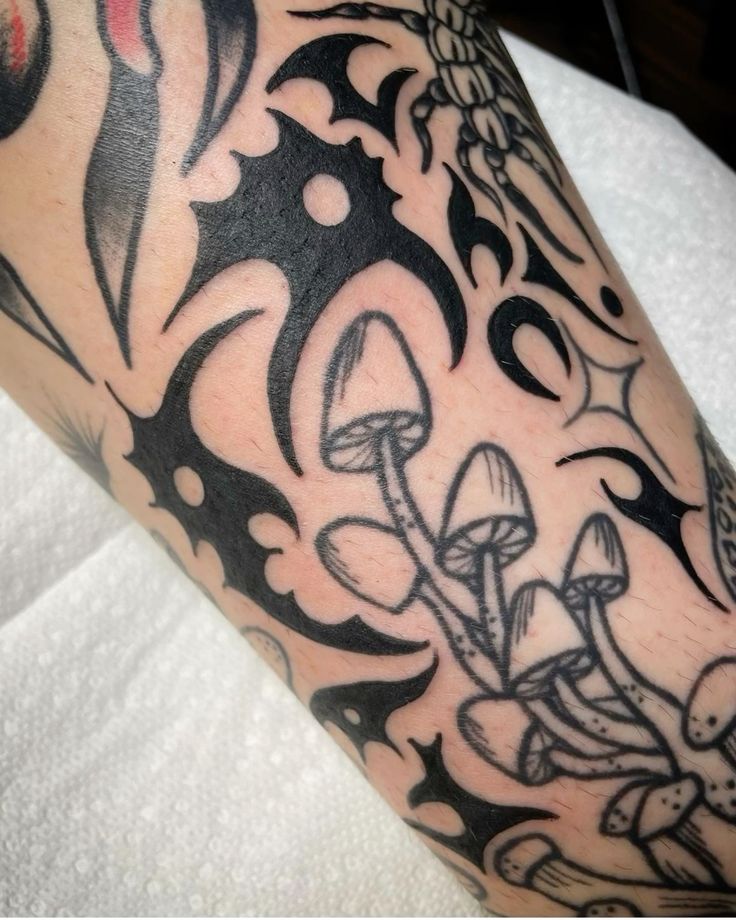
Mushrooms may be the recognizable subject here, but those sharp black shapes around them completely change the mood. The filler curls and stretches through the remaining skin like shadows, creating dramatic pockets of contrast around delicate outlines and a small web detail. There is a slightly gothic, slightly psychedelic feel to the arrangement that makes the woodland imagery look much less predictable. This is a clever way to take softer illustrative pieces and give them more attitude without altering the tattoos themselves.
When using heavy black around finer designs, placement matters more than quantity. Ask your artist to position the darkest filler where it can frame rather than swallow the existing pieces, leaving visible skin around important outlines. These kinds of ideas in men’s collections often use bold black to create structure, but the same technique works beautifully for women who enjoy darker, more experimental sleeves. Start with one or two awkward gaps before committing to the entire arm. Once you see how the black changes the balance, additional shapes can be added gradually and matched to the existing flow.
20. Stars and Sparkles Around Moon Phase Tattoos
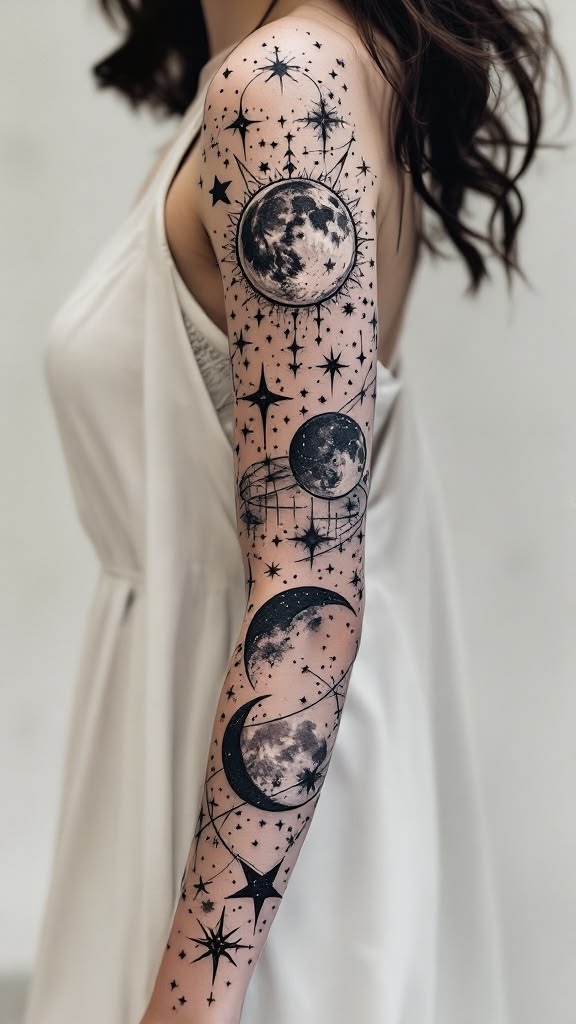
Few fillers are as naturally suited to celestial tattoos as stars, and this sleeve shows why. Large moons create the main vertical story while dozens of tiny sparkles, dots, orbit-like lines, and starbursts fill the surrounding skin with movement. The smaller marks make the empty areas feel like deep space rather than unfinished gaps, yet they never compete with the textured lunar surfaces. It has that dreamy, slightly magical quality that can make a full sleeve feel surprisingly light despite covering so much of the arm.
Celestial filler is wonderfully adaptable for sleeve designs because stars can be made almost any size and placed in spaces that would be impossible for more detailed images. Varying four-point, six-point, and tiny dotted stars keeps the background from looking repetitive. It is also wise to leave a little more negative space around the moons so their silhouettes stay crisp from a distance. For anyone collecting cosmic pieces over time, this is an easy way to connect older and newer tattoos while preserving the feeling that each moon remains an individual focal point.
21. Starry Dotwork Around a Planetary Sleeve
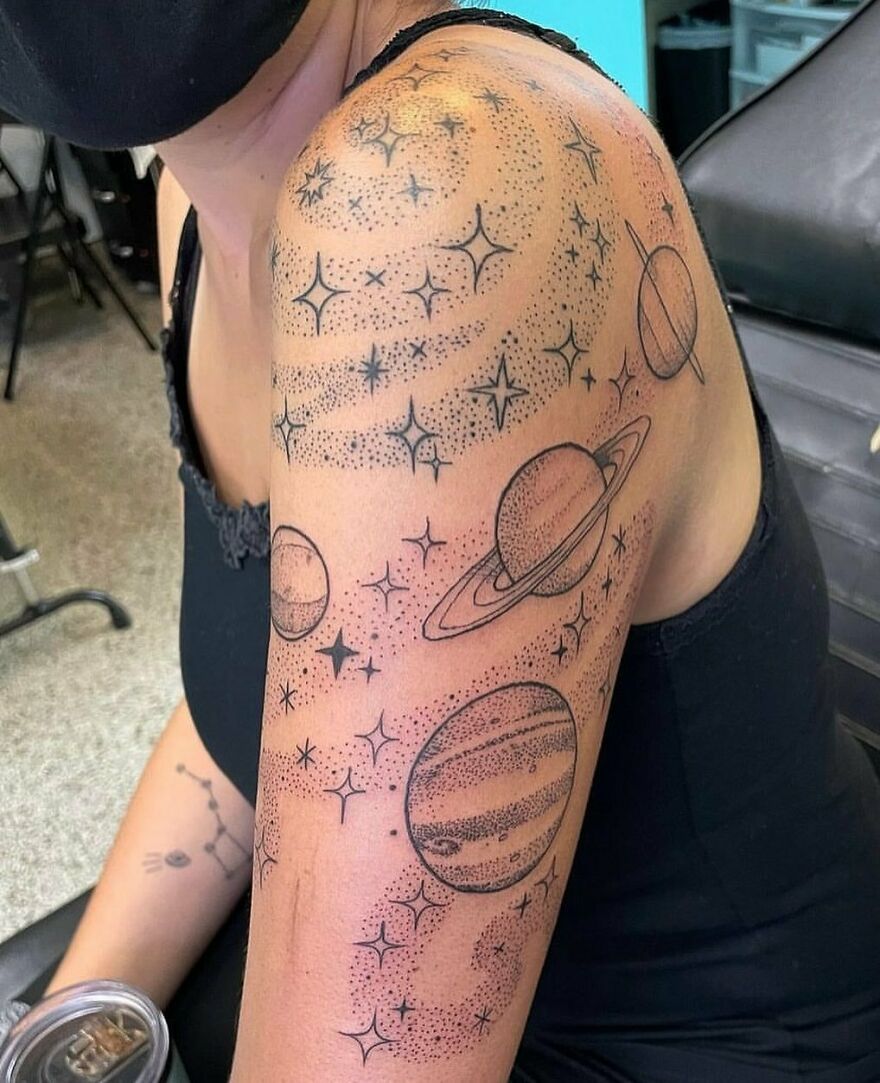
This celestial design shows just how effective tiny filler can be when the main tattoos already have plenty of personality. Several planets form the larger focal points, while clusters of delicate dots, scattered stars, tiny crosses, and sparkling four-point shapes sweep around them like little trails of cosmic dust. What I love most is that the background never feels mechanically repeated. Some areas are dense and misty, while others are left almost completely open, giving the planets plenty of room to stand out. Among tattoo filler ideas, this is such a pretty reminder that filling space does not have to mean covering every inch of skin.
For sleeve designs like this, ask your artist to build the filler gradually rather than creating one uniform star field. Dot density can increase around larger gaps and fade naturally near the edges of a planet, which makes the whole composition feel much more atmospheric. Small stars are also incredibly practical for curved areas around the shoulder and upper arm because their size can change without disrupting the theme. This works beautifully for women and men who already have celestial pieces and want a softer way to connect them. Keeping several untouched areas of skin is important too; that negative space prevents the stars and dotwork from flattening into one busy background.
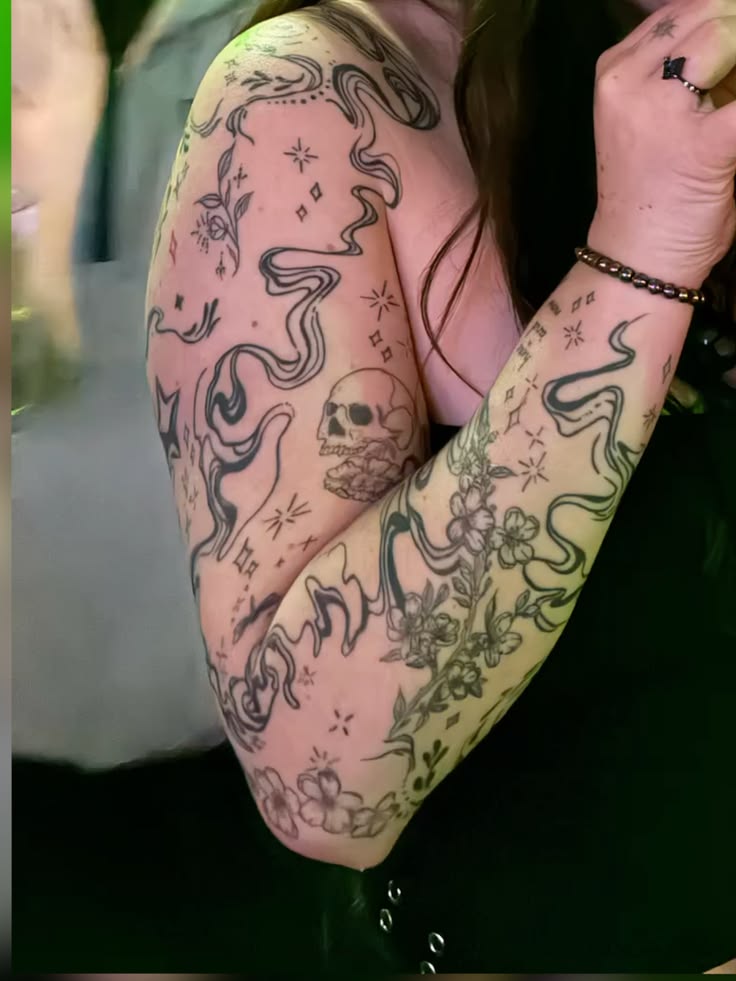
22. Flowing Ribbon Filler with Tiny Stars and Florals

These loose, ribbon-like lines give the arm a beautifully restless energy. They twist around flowers, a skull, and smaller illustrative pieces, filling long awkward spaces that would be difficult to handle with conventional motifs. Tiny sparkles and diamond shapes appear between the curves, adding just enough detail without turning the background into visual clutter. The finished look feels artistic, a little mysterious, and wonderfully personal. Instead of disguising the fact that the sleeve was built from separate pieces, the filler celebrates that collected quality and gives everything a shared sense of motion. It is especially striking if you like Patchwork but want the overall result to feel more connected.
This type of filler works best when the flowing lines are drawn specifically around your existing tattoos rather than copied from a fixed stencil. Ask your artist to follow the natural direction of the arm and vary the thickness and spacing of the ribbons so they do not look repetitive. It is a particularly clever choice for narrow spaces between pieces, because a curve can expand, taper, or bend wherever needed. If you are exploring ideas for women or ideas for men with backgrounds with a modern edge, this approach offers much more freedom than traditional stars and dots alone. Leaving the filler open rather than heavily shaded also helps older tattoos remain easy to read.
23. Small Traditional Dagger and Sparkle Gap Fillers
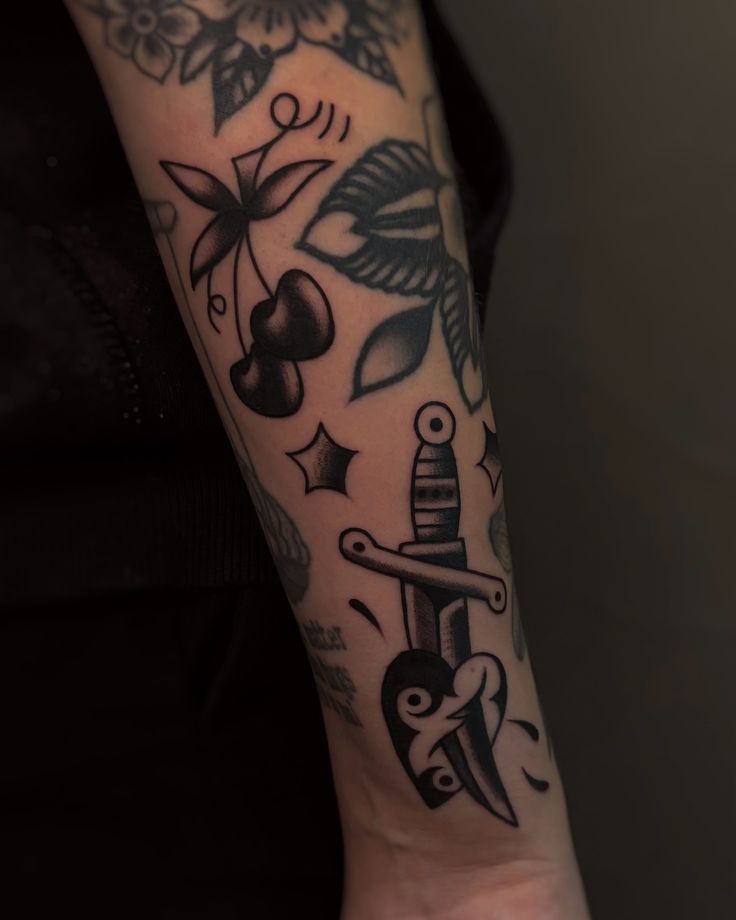
A little dagger can do a surprising amount of work in a narrow gap. Here, the compact blade sits among cherries, leaves, flowers, and small star shapes, becoming part of the collection without demanding the attention of a much larger tattoo. The heavy black outlines and simple shading keep everything visually connected, while the tiny sparkles and curved accents fill the smallest leftover spaces around it. I like how unapologetically classic this feels. There is no attempt to make every piece tell the same story; instead, the shared traditional language gives the sleeve its personality. It is exactly the kind of filler that makes a growing collection feel richer rather than simply more crowded.
Small traditional designs are especially useful for patchwork sleeves because recognizable motifs can be scaled down without losing their character. Daggers, cherries, stars, hearts, flames, and tiny flowers all work well as filler for sleeve gaps, but the trick is choosing the shape that naturally fits the available space. A long dagger suits a vertical opening far better than a round design, while little stars can handle the tiny corners around it. This approach works equally well for men and women who enjoy American traditional tattooing and want to build their sleeve slowly. Matching the line weight and black saturation of existing pieces will make new filler look like it has always belonged there.
The nicest thing about filler is that there really is no single right way to use it. A few scattered stars might be all your sleeve needs, while another collection may come alive with flowers, ornamental dotwork, tiny traditional pieces, or dramatic black shapes. The goal is not simply to cover empty skin—it is to make the spaces between your favorite tattoos feel just as intentional as the pieces themselves.
If you are still building your collection, there is no need to rush and fill every gap at once. Let the sleeve evolve, see which spaces continue to bother you, and work with an artist who understands how line weight, scale, negative space, and movement fit together. The best tattoo filler ideas should make your existing tattoos look even better while adding another little layer of your personality. And sometimes that tiny star, leaf, curl, or flower tucked into an awkward corner is exactly what makes the whole arm finally feel finished.